
High school sports play a critical role in students’ development, providing opportunities for physical activity, teamwork, and personal growth. A key component in expediting these experiences is the sports facilities available to students. These facilities not only support athletic programs but also serve as vital hubs for the entire school community. These facilities are crucial, if not paramount, not only to the school environment but to community relations as well.
Recently, I sat down with Orange County High School (OCHS) Athletic Director Mike Neeley to discuss the most recent improvements and upgrades associated with the Hornet sports program and the potential effects these elevations may have on the community as a whole. Modernizations to the Hornet Sports Center and the outdoor track were highlights in the most contemporary conversions.
According to Neeley, “We’ve done quite a lot of facility upgrades, and we’re continuing to look at them and plan them out in the hopes of continuing to improve our facilities. We had the floor in the basketball gymnasium completely redone, and we’ve gotten an LED score table, which is fun. You can really pump up the crowd with that. We truly have a really nice indoor facility now, and we’re looking at getting some wall padding to make it even nicer.”
Neeley also excitedly added, “We completely redid the track field out here, and we’re also looking to redo the track surface—repair it and repaint it.”
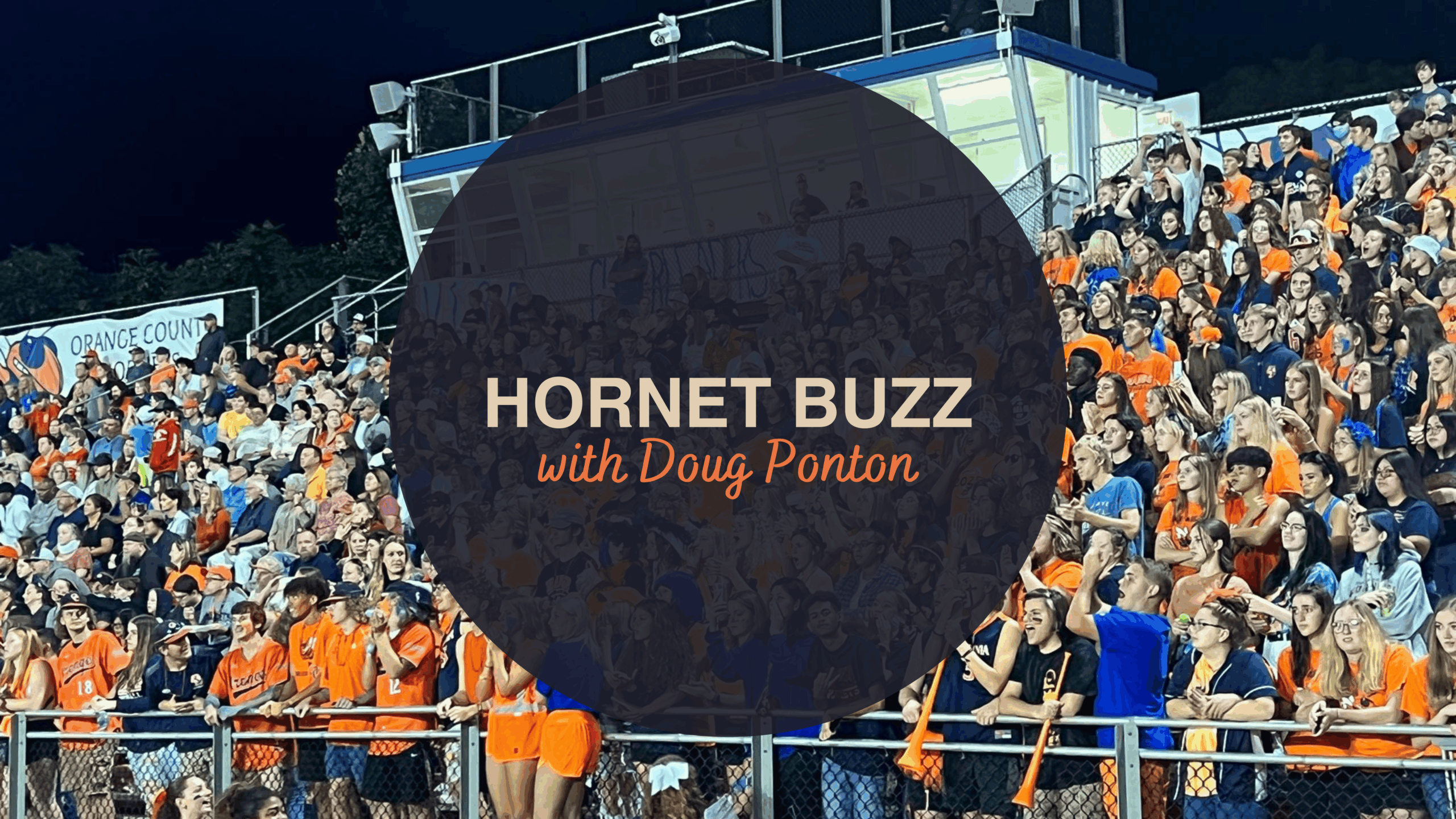
Sporting events are a cornerstone of high school life, bringing together students, faculty, and families. When schools have designated sports facilities, they create an environment that fosters school spirit and camaraderie among all involved. Whether it’s “Friday Night Lights” football games, basketball games, field hockey, lacrosse, soccer, volleyball matches, or an afternoon baseball outing, all these contests can transform a community as folks gather to support their teams. This unity strengthens the bonds between students, parents, and the school proper, cultivating a sense of belonging and pride.
Said Neeley, “Eventually, the plan—the vision, if you will—is to move our Olympic sports over here on campus so that we would have an Olympic sports stadium in addition to a football stadium at Porterfield Park. Out here on the track field, we would play sports like soccer, lacrosse, and field hockey on the grass surface for now, but maybe one day turn it into a turf field. In order to play here, though, we’re going to need to install a better set of bleachers, a scoreboard, and some lights. We did the improvements on the field, so that’s going to be ready no matter what, but in order to get a game field, we’re going to have to make a few more improvements. That’s probably not going to happen this year—that would be very tricky to do by spring—but hopefully, in the next year or two, we’ll have that completed.”
Quality sports facilities also represent an investment in the community. Local governments and school boards often collaborate to enhance these services, leading to improved resources for everyone.
Community members might utilize the gym for fitness classes or the fields for recreational leagues, thereby maximizing the use of these structures—something of which Neeley is acutely aware.
“I thought about asking the community to do some sort of fundraising, but it’s a pretty big ask with the quotes for everything that I’ve received. It would be nice to get some donations to help out, but it’s going to take more than a bake sale. It’s a good amount of money, but it’s not impossible because there are some very generous people in the community. Any contributions will go a long way.”
Another actuality that is not lost on Neeley is that the overall importance of high school sports and facilities extends far beyond the physical realm. They are integral to the fabric of the school community, promoting health, unity, and personal growth. By investing in and prioritizing the development of these amenities, schools can empower students to thrive both on and off the field, creating a lasting impact on future generations of their community.
“We just had a meeting with the county administrators a couple of weeks ago, and basically, we just gave them an overview of our vision and also a brainstorming session on practice spaces on our campus here. It’s kind of limited—we’re boxed in, we can’t expand but so much—and with the addition of the CTE facility, we’re going to be losing one of our two fields. As of now, the track field has traditionally been a practice facility, but if it is going to be a game venue, a grass field, then you don’t want to overuse it with practice. So, we have been looking at how to possibly bus kids to practice facilities, and we were brainstorming about what field space is available and how we can make it into a viable athletic field space.”
A robust range of sports venues and facilities enables schools to offer a variety of athletic programs, providing opportunities while catering to diverse interests and abilities. Whether it’s track and field, soccer, swimming, wrestling, or fitness classes, having the right facilities ensures that every student finds an avenue to participate, regardless of their skill level. This inclusivity fosters a culture of participation, allowing every student the chance to build conviction, self-confidence, and assurance. In a similar thought process, Neeley noted other considerations for advances and possible expansions.
“We have a fitness center, a weight room facility at the old gym at the high school. Half of the gym is the weight room, and the other half of the gym is a wood floor space, kind of a multi-use space. We use it for training purposes, practice space, testing space, classroom space, etc.,” Neeley said. He went on to explain that plans are underway to eventually relocate the weight room to the Field House. Neeley also noted the demand for more indoor court space—both from within the school and the wider community—and acknowledged that expanding these facilities would help meet that need.
Well-equipped sports facilities and value-added frameworks draw attention to the school and the community and provide a platform for students to flourish and prosper. On the cusp of innovation, OCHS is increasingly moving in a positive direction, with its inventiveness regarding its current accommodations, while substantially enhancing its overall activity climate with its breakout approach for a promising and engaging future. Read more at https://orangevirginia.com/hornets.

I am sixth generation Orange County, Virgina. Our family farm is a Century Farm in Barboursville, established in 1848.
I graduated Orange County High School in 1977, received a Bachelor’s degree from James Madison University in Kinesiology/Physiology and attended the University of Virginia for graduate school (K-12 education).
I had a 30-year Personal Training Practice, retiring from that aspect of my life in 2017. This is my 37th year as a sportswriter, mainly with the Orange Review but for various newspapers across the Commonwealth. Currently, I have a podcast, “Hornet Buzz with Doug” that covers all Orange County High School sports and activities.
My wife Elaine and I celebrated our 16th Wedding Anniversary this past June (2025)
Subscribe for Updates
Sponsors


Latest Articles
March 2, 2026
Cowgirls (and Boys) Become Weekend Phenomenon at Unionville Brewery

March 2, 2026
County Program Launches Outdoor Adventure Series
March 2, 2026
Clearwater Fire Grill Remains a Steady Presence in Locust Grove
March 2, 2026
Coopers Cookin’ & Catering Connects Orange to a Reconstruction Era Food Tradition
March 2, 2026
New Police Chief, New Town Manager Mark a Shift in Orange Leadership

March 2, 2026
From 3 to 7%: How Mortgage Rates Reshaped the Housing Market and What it Means for 2026

High school sports play a critical role in students’ development, providing opportunities for physical activity, teamwork, and personal growth. A key component in expediting these experiences is the sports facilities available to students. These facilities not only support athletic programs but also serve as vital hubs for the entire school community. These facilities are crucial, if not paramount, not only to the school environment but to community relations as well.
Recently, I sat down with Orange County High School (OCHS) Athletic Director Mike Neeley to discuss the most recent improvements and upgrades associated with the Hornet sports program and the potential effects these elevations may have on the community as a whole. Modernizations to the Hornet Sports Center and the outdoor track were highlights in the most contemporary conversions.
According to Neeley, “We’ve done quite a lot of facility upgrades, and we’re continuing to look at them and plan them out in the hopes of continuing to improve our facilities. We had the floor in the basketball gymnasium completely redone, and we’ve gotten an LED score table, which is fun. You can really pump up the crowd with that. We truly have a really nice indoor facility now, and we’re looking at getting some wall padding to make it even nicer.”
Neeley also excitedly added, “We completely redid the track field out here, and we’re also looking to redo the track surface—repair it and repaint it.”
Sporting events are a cornerstone of high school life, bringing together students, faculty, and families. When schools have designated sports facilities, they create an environment that fosters school spirit and camaraderie among all involved. Whether it’s “Friday Night Lights” football games, basketball games, field hockey, lacrosse, soccer, volleyball matches, or an afternoon baseball outing, all these contests can transform a community as folks gather to support their teams. This unity strengthens the bonds between students, parents, and the school proper, cultivating a sense of belonging and pride.
Said Neeley, “Eventually, the plan—the vision, if you will—is to move our Olympic sports over here on campus so that we would have an Olympic sports stadium in addition to a football stadium at Porterfield Park. Out here on the track field, we would play sports like soccer, lacrosse, and field hockey on the grass surface for now, but maybe one day turn it into a turf field. In order to play here, though, we’re going to need to install a better set of bleachers, a scoreboard, and some lights. We did the improvements on the field, so that’s going to be ready no matter what, but in order to get a game field, we’re going to have to make a few more improvements. That’s probably not going to happen this year—that would be very tricky to do by spring—but hopefully, in the next year or two, we’ll have that completed.”
Quality sports facilities also represent an investment in the community. Local governments and school boards often collaborate to enhance these services, leading to improved resources for everyone.
Community members might utilize the gym for fitness classes or the fields for recreational leagues, thereby maximizing the use of these structures—something of which Neeley is acutely aware.
“I thought about asking the community to do some sort of fundraising, but it’s a pretty big ask with the quotes for everything that I’ve received. It would be nice to get some donations to help out, but it’s going to take more than a bake sale. It’s a good amount of money, but it’s not impossible because there are some very generous people in the community. Any contributions will go a long way.”
Another actuality that is not lost on Neeley is that the overall importance of high school sports and facilities extends far beyond the physical realm. They are integral to the fabric of the school community, promoting health, unity, and personal growth. By investing in and prioritizing the development of these amenities, schools can empower students to thrive both on and off the field, creating a lasting impact on future generations of their community.
“We just had a meeting with the county administrators a couple of weeks ago, and basically, we just gave them an overview of our vision and also a brainstorming session on practice spaces on our campus here. It’s kind of limited—we’re boxed in, we can’t expand but so much—and with the addition of the CTE facility, we’re going to be losing one of our two fields. As of now, the track field has traditionally been a practice facility, but if it is going to be a game venue, a grass field, then you don’t want to overuse it with practice. So, we have been looking at how to possibly bus kids to practice facilities, and we were brainstorming about what field space is available and how we can make it into a viable athletic field space.”
A robust range of sports venues and facilities enables schools to offer a variety of athletic programs, providing opportunities while catering to diverse interests and abilities. Whether it’s track and field, soccer, swimming, wrestling, or fitness classes, having the right facilities ensures that every student finds an avenue to participate, regardless of their skill level. This inclusivity fosters a culture of participation, allowing every student the chance to build conviction, self-confidence, and assurance. In a similar thought process, Neeley noted other considerations for advances and possible expansions.
“We have a fitness center, a weight room facility at the old gym at the high school. Half of the gym is the weight room, and the other half of the gym is a wood floor space, kind of a multi-use space. We use it for training purposes, practice space, testing space, classroom space, etc.,” Neeley said. He went on to explain that plans are underway to eventually relocate the weight room to the Field House. Neeley also noted the demand for more indoor court space—both from within the school and the wider community—and acknowledged that expanding these facilities would help meet that need.
Well-equipped sports facilities and value-added frameworks draw attention to the school and the community and provide a platform for students to flourish and prosper. On the cusp of innovation, OCHS is increasingly moving in a positive direction, with its inventiveness regarding its current accommodations, while substantially enhancing its overall activity climate with its breakout approach for a promising and engaging future. Read more at https://orangevirginia.com/hornets.
I am sixth generation Orange County, Virgina. Our family farm is a Century Farm in Barboursville, established in 1848.
I graduated Orange County High School in 1977, received a Bachelor’s degree from James Madison University in Kinesiology/Physiology and attended the University of Virginia for graduate school (K-12 education).
I had a 30-year Personal Training Practice, retiring from that aspect of my life in 2017. This is my 37th year as a sportswriter, mainly with the Orange Review but for various newspapers across the Commonwealth. Currently, I have a podcast, “Hornet Buzz with Doug” that covers all Orange County High School sports and activities.
My wife Elaine and I celebrated our 16th Wedding Anniversary this past June (2025)
Subscribe for Updates
Sponsors
latest articles
March 2, 2026
Cowgirls (and Boys) Become Weekend Phenomenon at Unionville Brewery
March 2, 2026
County Program Launches Outdoor Adventure Series
March 2, 2026
Clearwater Fire Grill Remains a Steady Presence in Locust Grove
March 2, 2026
Coopers Cookin’ & Catering Connects Orange to a Reconstruction Era Food Tradition
March 2, 2026
New Police Chief, New Town Manager Mark a Shift in Orange Leadership
March 2, 2026
From 3 to 7%: How Mortgage Rates Reshaped the Housing Market and What it Means for 2026
Coopers Cookin’ & Catering Connects Orange to a Reconstruction Era Food Tradition
Newly relocated at 141 Caroline Street in Orange, Coopers Cookin’ & Catering serves Southern staples rooted in a family history…
Article By Judi Cooper
New Police Chief, New Town Manager Mark a Shift in Orange Leadership
The Town of Orange opened 2026 with a series of major leadership changes, headlined by the appointment of Rebecca Davis…
Article By Judi Cooper

The OCHS Alumni and Friends Foundation Part Two: Interview with Founder Bill Hager
It is often said that graduation is not the end, but the beginning of a lifelong relationship with one’s alma…